
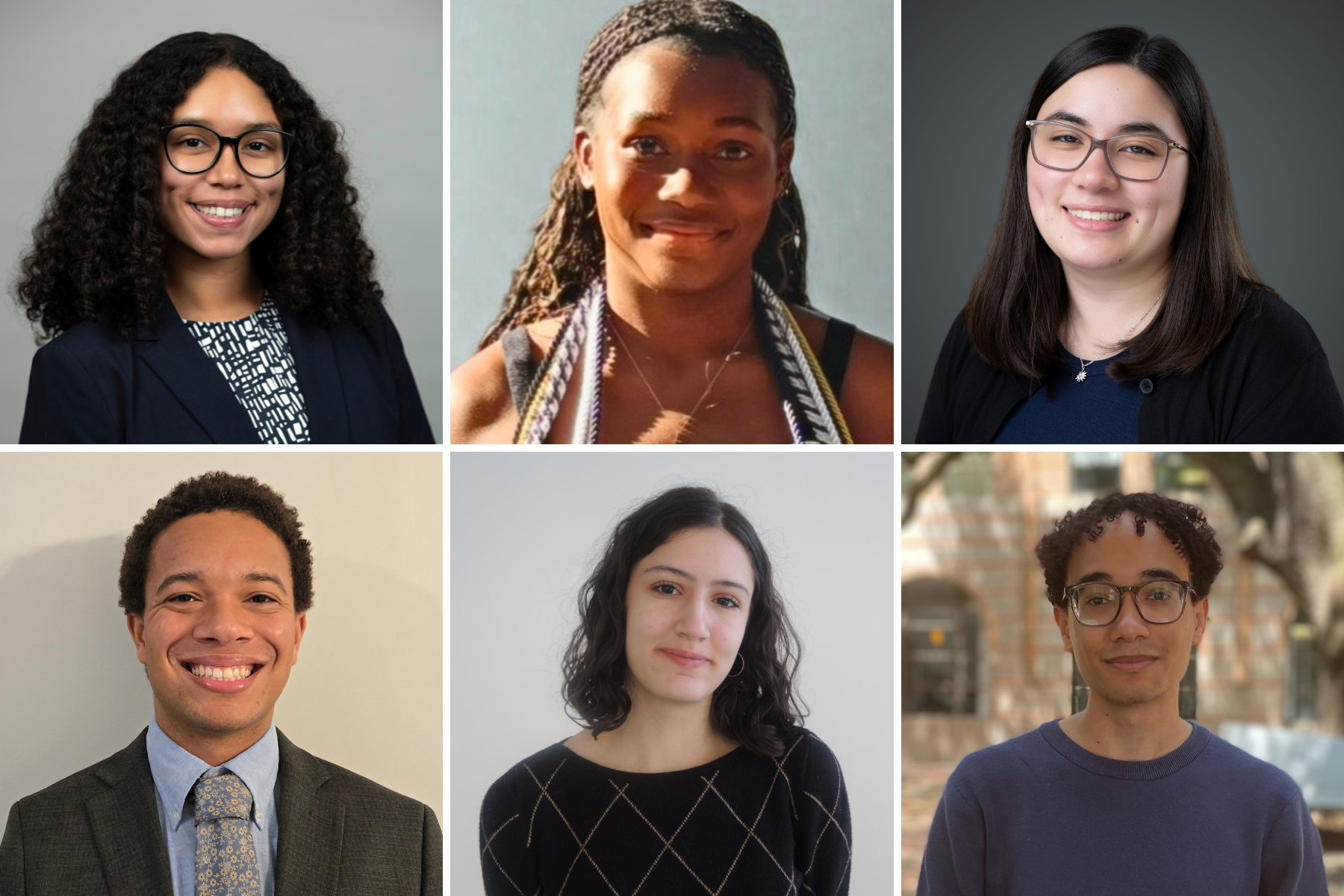
ISR welcomes the 2026 Junior Professional Researcher cohort
May 26, 2026
ANN ARBOR — Six young researchers will join the Institute for Social Research as the 2026 Junior Professional Research Researcher cohort this summer. Over the next two years, these six researchers will embed in projects throughout ISR, sharpening their research skills and building key professional skills as they contribute to key initiatives throughout ISR’s five centers.
They come from diverse and varied backgrounds, but all share a common goal and purpose: to advance the social sciences through rigorous research, no matter what research interest they may pursue.
Vanya Funez
Funez joins ISR after completing a bachelor’s degree in economics at Williams College with concentrations in coastal and ocean studies as well as Latina/o/x studies in 2026. While there, she completed a senior thesis focusing on the impact of congestion pricing on emergency medical service response times in New York City. Her research interests center on public and urban economics, and she’ll bring that focus to the Youth Policy Lab, where she hopes to further those interests while sharpening her statistical techniques and research methods while laying the groundwork for a future Ph.D. in economics.
Heaven Divinity
Divinity received her bachelor’s degree in psychology from Georgia Southern University in 2024. In her most recent role as a research assistant at the Social Cultural, and Interpersonal Processes (SCIP) Laboratory at Georgia Southern, she contributed to several publications and conference presentations under the guidance and mentorship of Dr. Virginia Wickline. A McNair scholar, Divinity’s research interests include the long-term effects of trauma within the family unit, the development of anxiety and its influence on social behavior, and evidence-based interventions that foster resilience.
Sofia Conway
Conway graduated with honors from the University of Richmond in 2024, double majoring in leadership studies and sociology. Though she is primarily interested in qualitative research methods, she also values mixed method approaches and perspectives. She put her mixed-method interests to work during a recent nine-month stint as a qualitative analysis intern for the Pew Research Center’s data labs. Her passion for how education and accessible information can affect positive change makes her new role in ISR’s Research to Practice Lab a natural fit. Conway hopes to pursue graduate studies in sociology and build a career in applied social research.
Zachary Kevala
Kevala joins the Panel Study of Income Dynamics after completing majors in economics and international relations at the University of Maryland, College Park, adding a minor in French. Kevala was a member of the Promoting Achievement and Diversity in Economics (PADE) program during his undergraduate studies, which supports academically distinguished students from traditionally underrepresented backgrounds as they pursue careers and education in economics. He’ll continue in that vein at ISR, pursuing broad academic interests in using economic analysis to shape public policy to improve material outcomes in the domains of finances and education while he looks ahead to graduate studies in economics.
Maria Benito
After completing a degree in economics at Macalester College in 2025, Benito has participated in various summer programs before arriving at ISR, including the University of Maryland Summer Research Initiative and the Federal Reserve Bank of St. Louis’ Summer Internship Program. With a research interest in agricultural economics, she’ll spend her time with the JPR program in the Surveys of Consumers working to deepen her understanding of economics by strengthening her coding skills and knowledge of research methods. Long term, she hopes to apply her knowledge by contributing to research that shapes agricultural policy that ultimately makes U.S. agriculture more sustainable.
Ian Wright
Wright completed his degree in economics and social policy analysis at Rice University this spring and now joins the Panel Study of Income Dynamics. As an undergrad, Wright conducted research on both the qualitative and quantitative aspects of inequality, completing a capstone research project during his senior year involving a spatial analysis of food insecurity across Galveston County, developing a methodology to identify optimal food pantry locations for a food rescue nonprofit. A former Public Policy and International Affairs Program (PPIA) fellow at the University of Michigan, Wright returns to U-M hoping to strengthen his research abilities and build meaningful relationships with his mentors and peers.
Contact: Jon Meerdink ([email protected])