
Black progress in real time—public art from Rick Lowe informed by U-M social research
September 24, 2026
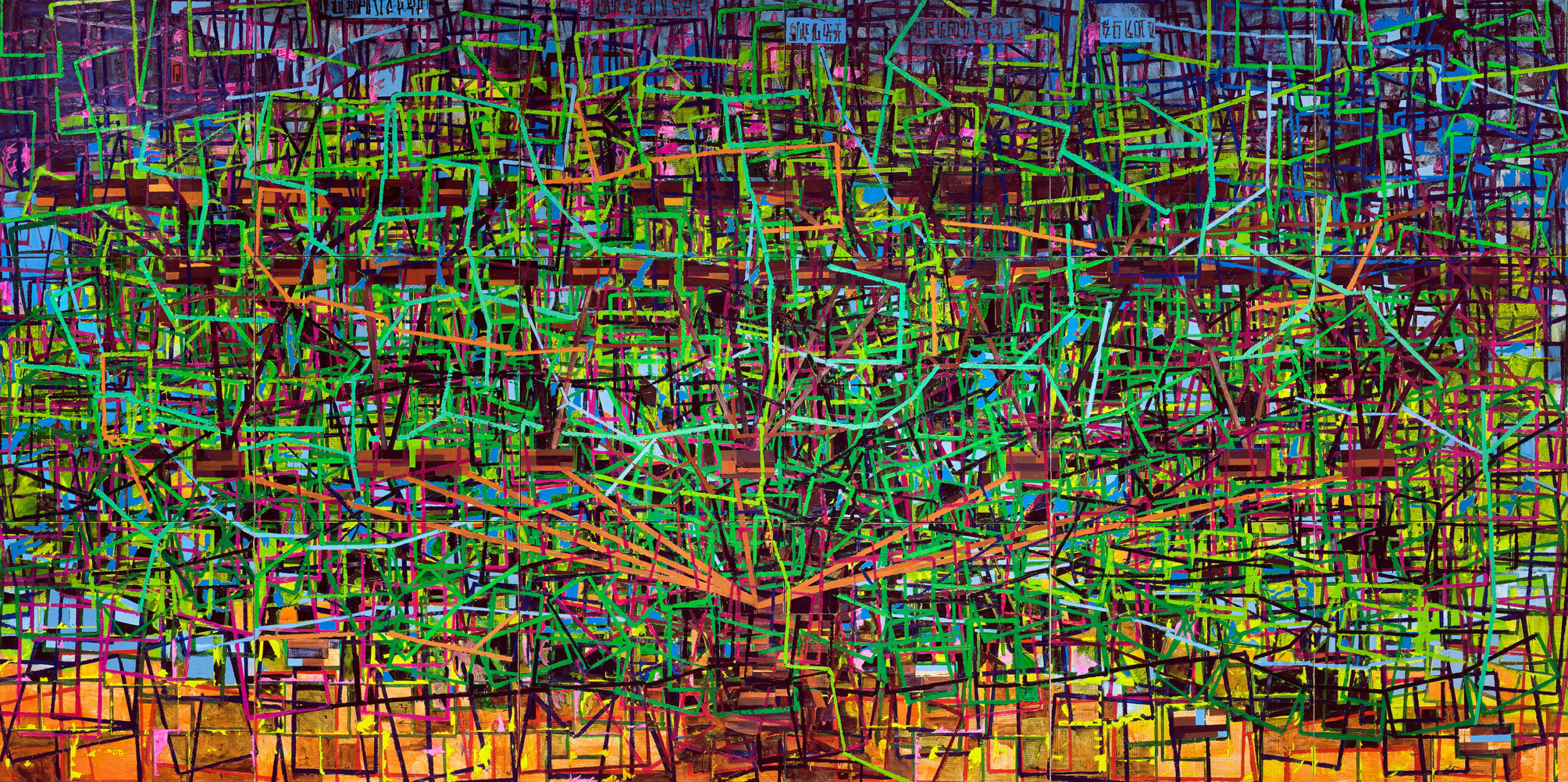
20 new works in Lowe’s largest U.S. solo exhibit to-date, ‘Black Wall Street Journey: Re and De Imagining Black Progress,’ which opens Sept. 26
ANN ARBOR—”The narrative around Black people, for me, is very problematic; it’s all about the deficit, the wealth gap … and to me that’s not inspiring to people,” said artist Rick Lowe on a recent episode of the University of Michigan Arts Initiative’s Creative Currents podcast.
Lowe, a MacArthur Fellow and artist in residence at the U-M Institute for Social Research, has decades of experience creating meaningful community-based arts projects. But upon learning about the multitrillion dollar contribution of the Black community to the U.S. economy each year, Lowe began thinking about how to gather, understand and represent that data in a way that could give the information life.
Like, for example, through a real-time stock ticker that could represent this buying power over the course of a year or a month, a day or an hour.
Creating the large-scale ticker installation—two, actually; one at ISR and one at the U-M Museum of Art—is something Lowe was ready to do. The challenge became how to find and mine the data that would be displayed on such a ticker.
That is where his work with ISR Director Kathleen Cagney ramped up. Cagney and the experts at ISR would help to explore the data around Black progress and break it down to the granular level that Lowe was after. She also installed Lowe as the institute’s first artist in residence, with help from the U-M Arts Initiative’s Creators on Campus program.
“Typically we think about the ticker as something that reads the health and well-being of the stock market,” Cagney said. “What emerged from our conversations was, why can’t it read out the health and well being of communities? Why have our tickers been confined to a certain kind of information, and not other forms of information that actually have more relevance for the greater share of the population?”
In an attempt to “reclaim” the information that is elevated for the public, the team dove into data from U-M’s Panel Study of Income Dynamics—the longest running longitudinal household survey in the world, and the Anti-Black Index—a historical data-collection project and measurement tool tracking anti-Black human rights violations and sentiment across U.S. counties from 1850 to 2010, developed by Christian Davenport, professor of political science and faculty associate at ISR.
Research sequences from these studies, as well as hieroglyphs and snippets of statistical code from the analysis of the PSID, is displayed on partner tickers installed outside on the roof at UMMA and in the atrium at ISR from Sept. 26 through Nov. 15—likely even longer inside of ISR.
“Public art invites us to see our surroundings in a new light. Having a major work by a leading contemporary artist like Rick Lowe that has been deeply informed by his time at U-M is incredibly special,” said Jenny Carty, U-M curator of art in public spaces.
“Rick Lowe’s Tickers seek to upend the dynamic of how information on the well-being of Black communities is produced, controlled and disseminated. The work explores data as both a tool of empowerment and form of exclusion. At over 50 feet in the air above UMMA’s rooftop, hanging in the center of ISR’s Atrium and featured in UMMA’s gallery, visitors will experience a series of Tickers with data from PSID and ABI as well as abstracted forms merging art and science into a singular artwork.”
As part of Lowe’s residency, he worked with researchers, data scientists, students and faculty to more deeply understand local and national patterns related to Black well-being, economic mobility and social progress.
The residency also included a two-course sequence with Abigail Winograd, guest curator of the Black Wall Street Journey exhibition at UMMA, and Davenport, titled POLSCI 489: De/Re-Imagining and Building Black Progress, and a close collaboration with Stamps School of Art & Design professor Nicole Marroquin’s course ARTDES 203: Social Spaces: The Role of Artists, Designers and Citizens.
In fact, Lowe’s work with students directly inspired the exhibition. Their art is featured as part of his sculpture “In Search Of,” and a wall filled with student-designed posters that investigate the history of print traditions as tools for communication, solidarity and collective action are displayed at both UMMA and ISR.
Riot vs. massacre
Bringing together painting, sculpture, public installation and social research, Black Wall Street Journey: Re and De Imagining Black Progress is the culmination of Lowe’s three years immersed in ISR research and working with U-M students. The exhibition features 20 new works created during his residency, and is the largest solo exhibition Lowe has had in the U.S.
Opening on Sept. 26, the exhibition will also feature two research stations, encouraging visitors to engage with the data from the PSID and ABI firsthand, and two smaller tickers inside the gallery reflecting that data.
The title of the exhibition is a nod to The Tulsa Race Riots—the name given to the burning down of the prosperous Greenwood neighborhood, known as “Black Wall Street,” in 1921. The historic event was renamed the Tulsa Race Massacre a hundred years after it took place, appropriately representing it as an attack which displaced 11,000 African American people, and killed many.
“I often think, ‘How did Rick lead us to rethink? What did he help us focus on?’ For one thing, when we think about deviations from the mean, that inhibits our ability to tell stories about progress in groups that are not fully represented by the mean,” Cagney said. “He’s forcing us to come to grips with these social observations that we take for granted, in a way, and don’t sit with.”
Cagney sees the value of having an artist in residence at a research institute as a way of challenging scientists who tend to stay in their own lanes, and finding bolder ways to share their findings.
“I want people to take some risks,” she said. “And if this gets people to think a little bit more carefully about the work—to really sit with fundamental questions about what social science is able to capture and what it is not—that’s a win in my mind.”
Black Wall Street Journey: Re and De Imagining Black Progress is free and open to the public through Jan. 24, 2027.
Related Event:
Black Wall Street Journey: In Conversation with Rick Lowe
Sat, Oct 10, 2026 | 1:00pm–2:15pm
University of Michigan Museum of Art, Helmut Stern Auditorium
Contact: Jamie Sherman Blinder, [email protected]