
How Rick Lowe’s ISR residency makes use of PSID data
October 30, 2026
ANN ARBOR — Rick Lowe’s exhibition of “Black Wall Street Journey” is the culmination of his three-year residency at the Institute for Social Research (ISR). It’s also the intersection of the worlds of art and social science, and that intersection itself has been in the works for nearly seven years.
ISR Director Kate Cagney began conversations about this collaboration with Lowe in 2019, as a member of the faculty at the University of Chicago, well before she took her present role at ISR. Those conversations blossomed into Lowe’s eventual residency at ISR, but that residency wouldn’t have been possible without data.
“Rick Lowe reminded social scientists that we often gravitate toward the mean, and when we gravitate toward the mean, it means that we are not necessarily drawing out subpopulations and looking at progress within those subpopulations. So one of his goals in this work was to describe African-American progress,” said Cagney in an open house about the work. “That led us to the PSID, because the PSID had samples of families over time where we could look at things like changes in home ownership, changes in education attainment, changes in wealth and income that characterize that community. So, we wanted to tell a story of progress.”
“Black Wall Street Journey” marries Lowe’s artistic vision with data from the Panel Study of Income Dynamics (PSID) to create a series of pieces touching on that story of Black progress in America.
Working with Lowe, Tom Crossley, director of PSID, Noura Insolera, assistant director of PSID, and Malak Kalasho, a member of the 2024 Junior Professional Researcher cohort at ISR, put together a series of indicators of Black well-being among PSID families, in addition to custom code to be included in Lowe’s artwork. Additional data and insight from ISR’s Christian Davenport also supported the development of the art.
The PSID data followed Black families dating back to 1968, from which Crossley, Insolera, and Kalasho were able to track several trends.
“We looked at the percent of families who owned a house or owned a business across years, as well as the number of people who graduated high school, college, or completed post-graduate studies, and many other socioeconomic trends,” said Kalasho. “It was really interesting to see the progress in those indicators over time, which is exactly what Rick wanted to show.”
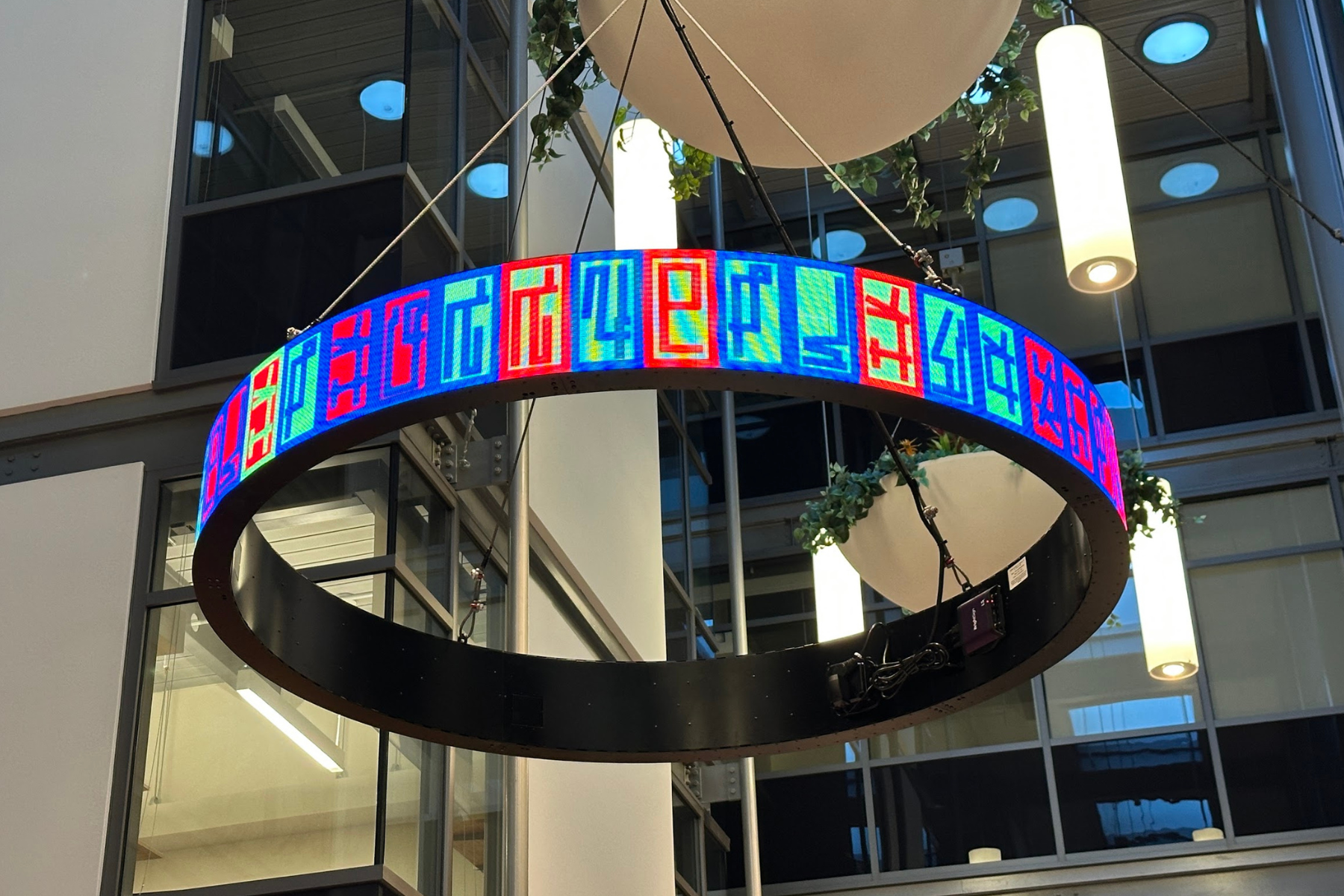
Lowe and the ISR team developed a series of graphs and trendlines to be used in a stock ticker-esque display, a play on the idea of Black Wall Street, which is both the title of the work and a reference to the destruction of the real-life Black Wall Street, which was largely destroyed in the two-day Tulsa massacre of 1921. The decision to build something resembling a stock ticker was an additionally meaningful choice, though, drawing the audience’s attention to the kind of metrics American culture pays attention to — and which ones it doesn’t.
“One of Rick’s early motivations was to think about what we really need to see on a stock ticker,” said Cagney. “Do we all need to see data on stocks in real time? Actually, what’s more meaningful to us is to see data about our community and about advancement in our community.”
The result is an exhibition that focuses on Black progress and resilience, economic, social, and health data from PSID, and, as it so happens, PSID itself.
“If you go into the UMMA, there’s a little PSID section,” said Insolera. “If you’ve ever been to my office, it looks awfully familiar. Rick said ‘I want to see your space, I want to see your desks.’ And Malak and I said “Our desks? Why?” and so you’ll see stuff resembling our desks in there. He kind of wanted to bring people into the data.”
The “Black Wall Street Journey” exhibition is on display at the University of Michigan Museum of Art (UMMA) with the Ticker installed on UMMA’s roof and in ISR’s atrium. For more information about the exhibition, visit the dedicated website or see this informational page from UMMA.
Contact: Jon Meerdink ([email protected])