
In rural Tanzania, solar-powered pumps bring clean water closer to home
August 3, 2026
ANN ARBOR—Around 10,000 people and thousands of livestock now have access to clean water in the Tanzanian villages of Esilalei and Oltukai, in the African country’s semi-arid Monduli District.
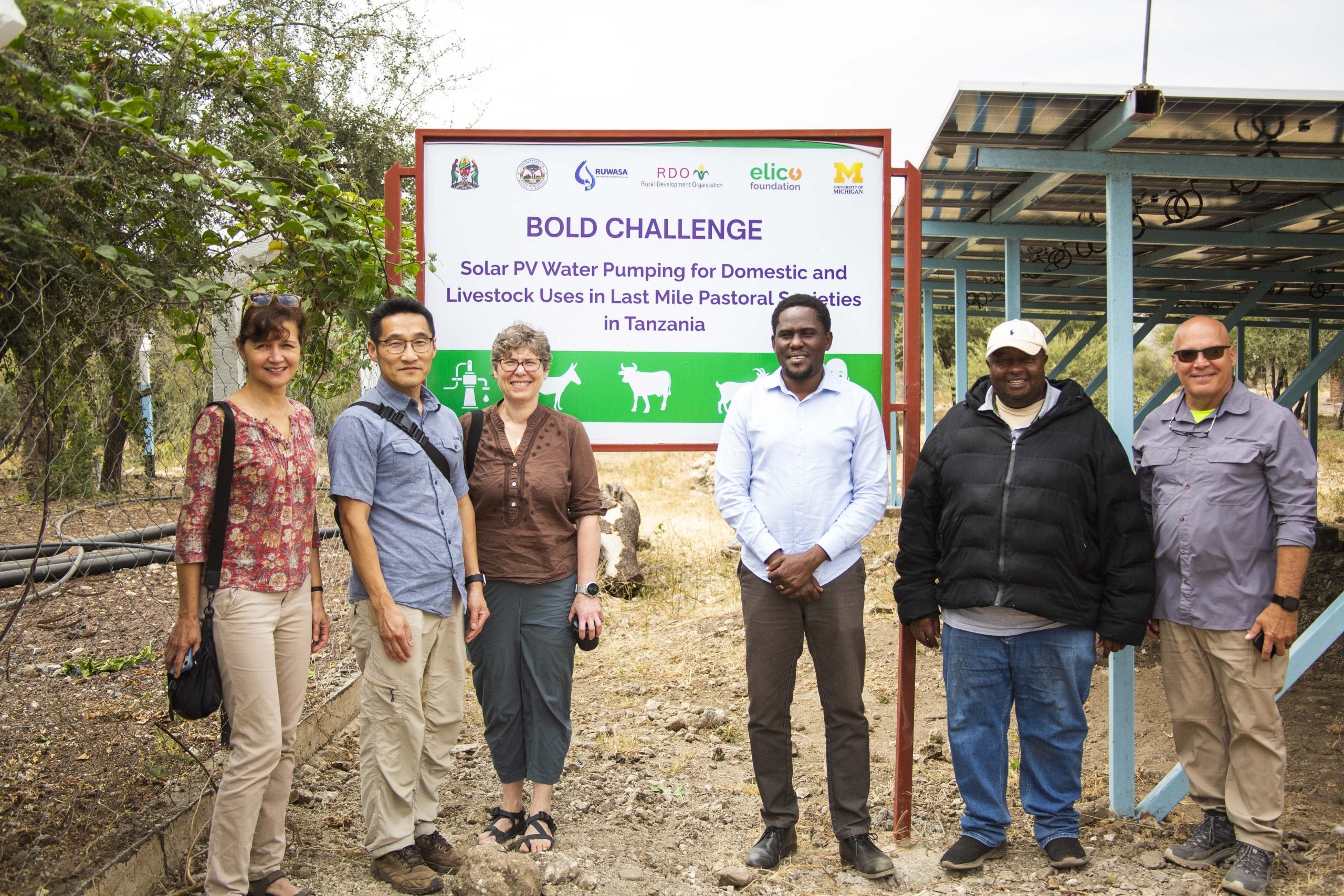
Researchers from the University of Michigan and the nonprofit ELICO Foundation built a solar-powered pumping system to supply water to about 3,000 pastoralist families, following two years of collaboration. The project expanded the local distribution network by about 10 miles.
“This solar-powered infrastructure eliminates dependence on fossil fuels or unreliable grid electricity, meeting the realities of remote pastoral communities,” said Brian Min, U-M associate professor of political science and research associate professor at the Center for Political Studies at the Institute for Social Research. “Water access remains low, even decades after independence. One in three Tanzanians do not have access to improved water. In rural areas, that rate is substantially higher.”
In Monduli District, communities navigate persistent water shortages caused by long dry seasons and high salt, phosphate and fluoride levels in underground supplies. Residents travel long distances or rely on expensive water deliveries to meet their families’ and livestock’s everyday needs when local streams and seasonal ponds dry up.
The project, “Solar PV Water Pumping for Domestic and Livestock Uses in Last Mile Pastoral Societies in Tanzania,” is led by Min and U-M colleagues Kelly Askew, professor of anthropology and of Afroamerican and African studies, and Aline Cotel, professor of civil and environmental engineering. It was selected in the 2024 Boost cohort of U-M’s BOLD Challenges Initiative.
The idea for a Bold Challenges project initially came from Sisty Basil Massawe while visiting the Great Lakes region as a U-M African Presidential Scholar. He is the executive director of ELICO Foundation, a Tanzanian NGO that promotes renewable energy systems and livelihood improvement.
“In Tanzania, water scarcity sparks resource conflicts, decimates herds, forces displacement and creates severe public health risks for Maasai families,” Massawe said. “We first went to Oltukai to bring solar and electricity energy access to their clinic. But even then, community residents were very clear that water remained their top priority. We realized we could use solar power to find a solution.”
Massawe partnered with Min, Askew and Cotel, uniting expertise across renewable energy systems, political economy, green engineering and rural Tanzanian communities.
A card, a tap, a turnaround
Pipelines brought water closer, but providing equitable and affordable access to households remained a challenge. U-M researchers and partners proposed a new solution: water ATMs.
In consultation with village leaders, the team installed four automated water kiosks for local distribution, drawing water from a large water tower in the center of Esilalei and another in Kanjiro subvillage, about 2.5 miles away.
Units were installed at a local clinic, two communal locations and one private site.
Three more are scheduled for installation in Oltukai village, bringing the total to seven new distribution points delivering clean water to both villages.
“Each household gets a card with credits,” said Askew, who is also a faculty affiliate at ISR’s Center for Political Studies. “They tap it against the dispenser and get 20 liters of water, which is the most common-sized bucket and carrying container. Families pay 20 shillings, less than one cent.”
The rate is lower than the actual cost of laying the entire infrastructure and building the system.
“These are marginalized and poor communities,” Cotel said. “The rate was designed to be affordable, especially since households need multiple refills per day. That money then goes into a community bucket, a fund that will support repairs or maintenance as needed.”
Tracking progress for future impact
There are many other areas and districts to expand into, researchers say. A key obstacle in water access to remote areas is the energy required to pump water long distances across pipelines or to power water pumps in deep boreholes. Solar-powered solutions can play a key role in addressing this challenge. Following the pilot project, researchers plan to track and evaluate the long-term impacts of clean water on local communities.
“The opportunity now is to carefully monitor and evaluate the impacts of improved water supply in this community that did not have it,” Min said. “Large-scale infrastructure projects often fail to reach the most remote, vulnerable populations facing shifting climate and rainfall patterns. Choosing the right technical solution is important, but only if it meets the needs of those who need it the most.”
Written by Fernanda Pires and Tevah Platt
Contact: Fernanda Pires, [email protected]