
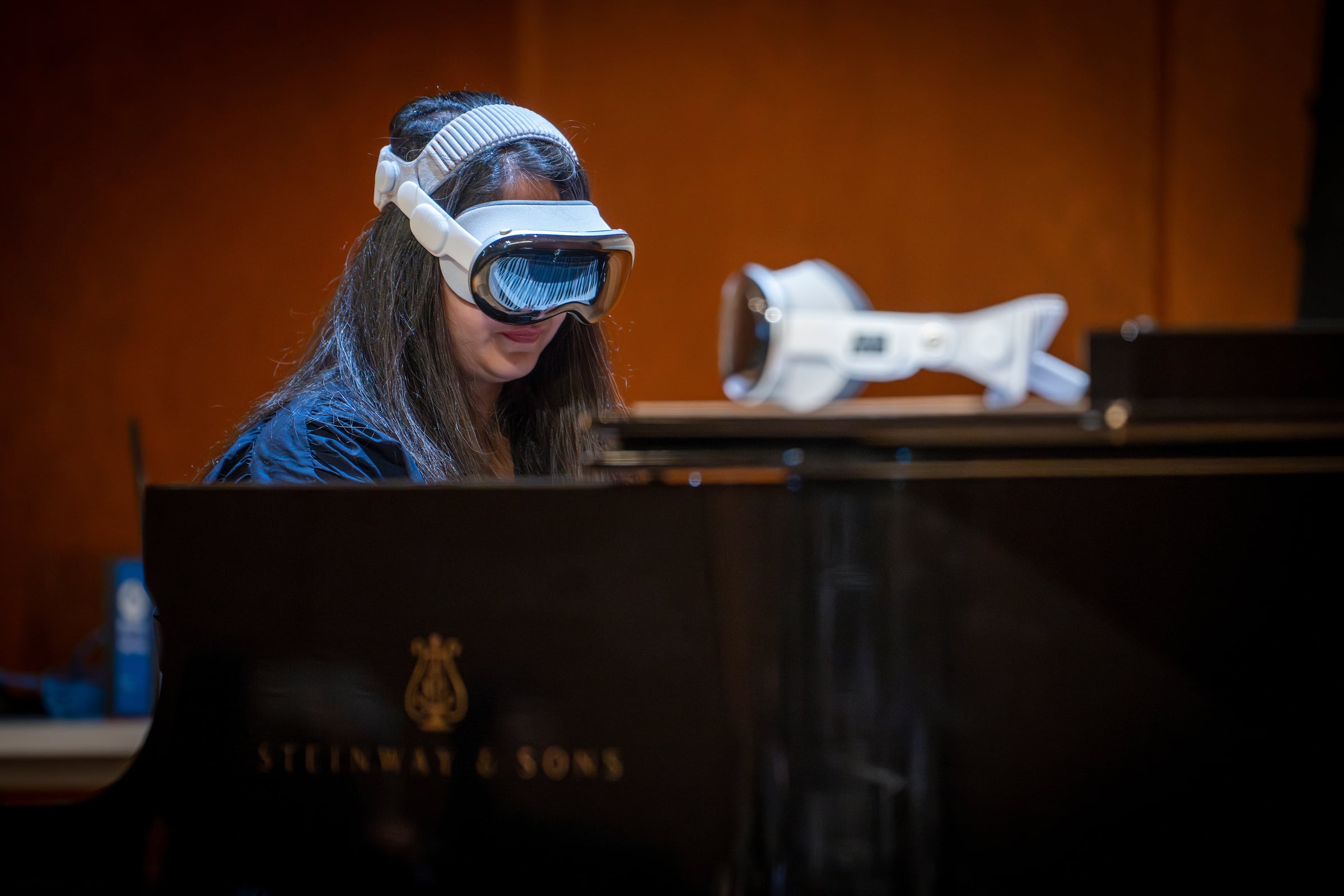
U-M piano students fight stage fright with VR
September 3, 2026
ANN ARBOR—As you walk onto the stage to perform a piano solo, you hear the echo of your shoes on the stage floor. You shield your eyes from the bright lights and take your seat at the grand piano.
Your nerves spike as the buzz of the audience falls to a hush. Your opening notes sweep across the venue, traveling from the keys under your fingers to the back of the house.
But this is all happening from the comfort of your classroom, not on a real stage with a live audience.
The University of Michigan’s Piano Lab Pro uses virtual reality to help students decrease music performance anxiety, or MPA, as they create and repeat the live performance experience, gaining comfort with the space, the acoustics of the hall and the challenges of audience distraction.
“I’m so happy and so excited because no other university in the U.S. has this, especially using individualized goggles. We are the first ones in the U.S. to incorporate this in a piano curriculum,” said Aya Higuchi Hagelthorn, lecturer of piano pedagogy, director of collegiate class piano and coordinator of the Piano Pedagogy Laboratory Program at the U-M School of Music, Theatre & Dance. “We can really change the lives of our students.”
Extended reality
Hagelthorn has seen the wide range of effects of MPA on students at high school and university age, through the professional level; some falling apart in the middle of an exam, leaving their performance in tears, or exhibiting anxious behaviors like repetitive hand washing ahead of performance time.
“You could just see that this was not healthy. So if there is even a small way, but also a cool, fun way, to help them get that feeling out of the way, and understand that feeling in a safe way, I think that is great,” she said.
With this goal in mind, Hagelthorn applied for, and received, a grant from U-M’s Center for Academic Innovation to explore the potential of extended reality in music education—the center’s first project using Apple Vision Pro.
Hagelthorn began collaborating with the center’s XR team on Piano Lab Pro to replicate the settings of U-M’s Britton Recital Hall, where most piano juries and student performances take place, and Hill Auditorium, a historic music venue with unique acoustic considerations, using VR.
Senses and sensibilities
The visual component is just one piece of the puzzle. Engaging as many senses as possible is what allows a virtual experience to be plausible and immersive, said Anıl Çamcı, director of graduate studies and associate professor of performing arts technology at SMTD, and a second investigator on the project.
“When you go on the stage in the Hill Auditorium, the grandeur of the space is amazing,” he said. “The audience is daunting, but one of the most critical aspects of that experience is that all of a sudden, the auditorium expands your instrument sonically. The auditorium itself becomes the instrument in a way.”
Çamcı, who Hagelthorn calls a “master of spatial audio,” and his graduate students, used different tools to capture the acoustic properties of both spaces. For example, they would pop a balloon in different areas of the auditoriums, which “lights up” the acoustics and allows the students to apply those sonic properties to the sound of a piano algorithmically.
They also collaborated on realistic audience distractions—coughing, laughing, a cell phone ringing, even just the murmur of a room full of people breathing.
“It’s critical to capture that in this experience as well, because without it, it’s missing a whole portion of the reality that you experience when you go on that stage,” Çamcı said.
Fight, flight or play
To understand the value of a tool like this, and to measure how the virtual environment affects performing musicians, Hagelthorn partnered with the Biosocial Methods Collaborative at the Institute for Social Research.
Rich Gonzalez, director of the Research Center for Group Dynamics at ISR, and his team designed the pilot phase of the Piano Lab Pro project using psychophysiological sensors and surveys to develop a protocol for identifying when anxiety sets in and how it affects performers. The sensors are strategically placed on the performer’s body, and performance video is annotated by the student to discuss what they were feeling as they played.
“The sensors really were picking up and corroborating what the musician was saying. When they said they felt nervous, the signal really did spike up, and so their physiology was corroborating their story,” said Alicia Carmichael, research process director at the Biosocial Methods Collaborative.
“The cleanest signal of the activation response turned out to be sweat, which we measured from the feet. When the musicians got nervous, we could detect minor fluctuations indicating the fight-or-flight response had been activated.”
Utilizing the psychophysiological insights, faculty have a new opportunity to customize the Piano Lab Pro experience. It can also offer insight for students into their own MPA.
“Being able to access this physiological information could help people become more aware of what’s going on in their bodies,” said Natalie Leonard, ISR research associate and architecture Ph.D. candidate at Taubman College of Architecture and Urban Planning.
Scaling up
The team has received a grant from the Arts-Integrated Grant Program, which offers funding for innovative projects and programs that increase arts access, activity and research, to continue their work this fall, and Hagelthorn intends to incorporate the new technology into some of her piano curriculum.
The AIGP funding will allow the team to add six more students to the study utilizing the physiological sensors, VR headset, and video recording, review and annotation following the performance.
Additionally, all piano students will have the opportunity to participate in MPA self-assessments, which help create a benchmark for each student, and access to recommended coping mechanisms to aid in working through their current levels of MPA.
A subset of piano students will be able to use Piano Lab Pro ahead of midterm and final exams, taking follow-up surveys after each exam, and will contribute their results and performance videos to the research team.
Gonzalez believes U-M’s unique collaboration between units across campus will be a key contributor to Piano Lab Pro’s future success. “It isn’t just adding a tool. It’s really thinking about the educational system and how this fits in,” he said.
Contact: Jamie Sherman Blinder, [email protected]